
Integral surgical kit
- 30 components in the kit 30 components in the kit
- Best value for money Best value for money
- Sterile Sterile

 New customer?



The layout of the reprocessing area Successful infection control is vital in all dentist...
Ergonomics in dental implantology is a fundamental aspect that ensures efficiency, safety, and comfort for both the practitioner and the patient. Dental implant procedures, often complex and lengthy, require special attention to workspace organization, the professional’s posture, and the appropriate use of instruments. Adopting good ergonomic practices in this field is not only beneficial for the practitioner's health but also optimizes clinical outcomes and reduces the risk of complications.
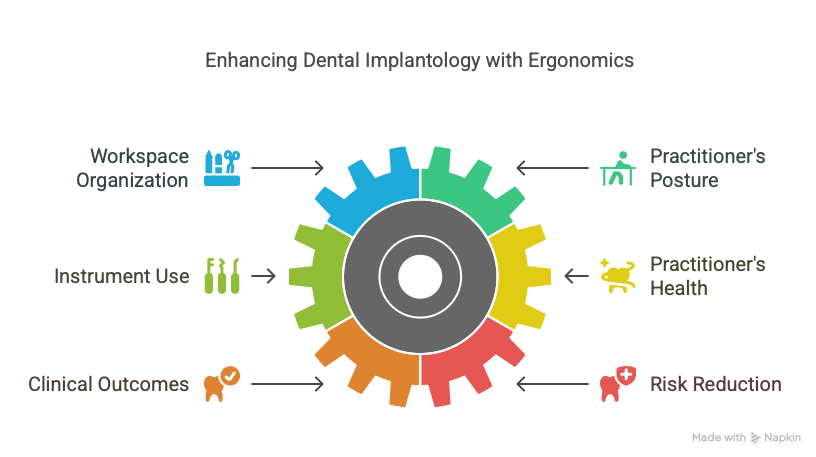
The posture of the practitioner during implantology procedures is crucial, not only for the professional’s long-term well-being but also for the quality of the work performed. In implantology, procedures are often carried out in hard-to-reach areas of the oral cavity, such as the mandible or the posterior region of the maxilla, requiring prolonged and sometimes uncomfortable postures.
Seated or standing position: Ideally, a seated posture should be adopted to maintain the spine in a neutral position. The chair should be adjusted to allow the practitioner to work with slightly flexed arms, helping to avoid muscle fatigue and lower back pain.
Head and neck posture: The head should be kept straight or slightly inclined, but never in an overly forced position. This helps prevent neck tension.
Height of the operating table: The table should be adjusted to a height that allows the arms to work at approximately a 90-degree angle. This reduces the risk of elbow and shoulder pain.
A well-organized and ergonomic workspace significantly improves the efficiency of procedures while reducing both physical and mental stress for the practitioner.
Instrument layout: Instruments should be logically arranged and easily accessible. A rotating storage system or a mobile stand with compartments dedicated to implantology instruments helps save time and minimizes unnecessary movements.
Lighting: Lighting must be adequate, without casting shadows, to provide optimal visibility of the surgical area. The use of LED headlamps or mounted surgical lights offers targeted illumination, which helps reduce eye strain.
Dental implantology requires high precision, and the use of suitable instruments is essential. The ergonomics of the instruments greatly affect the practitioner's performance and endurance. Many manufacturers now offer instruments specifically designed for implantology, with non-slip grips, hand-friendly shapes, and optimized weights for prolonged use.
Rotary instruments: Turbines and contra-angles, essential in implant surgery, should be lightweight, well-balanced, and allow for optimal control. Excessive weight can lead to muscle fatigue, especially during lengthy procedures.
Implants and screws: The design of implants must allow easy handling while ensuring adequate stability. It is important to use instruments that meet ergonomic standards to avoid applying excessive force when inserting implants.
Managing time during implantology procedures is crucial to avoid excessive fatigue. Implant surgeries can be long and require maximum concentration.
Management of procedure duration: The practitioner should be attentive to signs of both physical and mental fatigue. Regular breaks are recommended to maintain optimal performance.
Pre-operative preparation: Careful preparation helps minimize the time spent searching for instruments or adapting to unforeseen situations. A well-defined plan and anticipation of procedural needs improve efficiency and reduce stress on the practitioner.
Poor ergonomics can lead to various risks for the practitioner, such as chronic musculoskeletal pain, eye strain due to poor head posture, and circulatory problems. If not addressed, these risks can result in prolonged absences or reduced productivity.
Studies on musculoskeletal disorders (MSDs) among dentists show that the spine, shoulders, elbows, and wrists are the most commonly affected areas. According to a systematic review of ergonomic risks in dentistry, professionals who do not consider these risk factors are more likely to develop chronic conditions such as tendinitis, lower back pain, or neck pain.
Ergonomics in dental implantology is essential for preserving the health of practitioners and ensuring high-quality patient care. By following appropriate ergonomic principles, practitioners can reduce the risk of injury and fatigue, and enhance their performance and efficiency during surgical procedures.


 Musculoskeletal strain in dentists: electromyographic and goniometric study